The market is becoming increasingly blunt about the Federal Reserve: do not expect a rate cut this year.
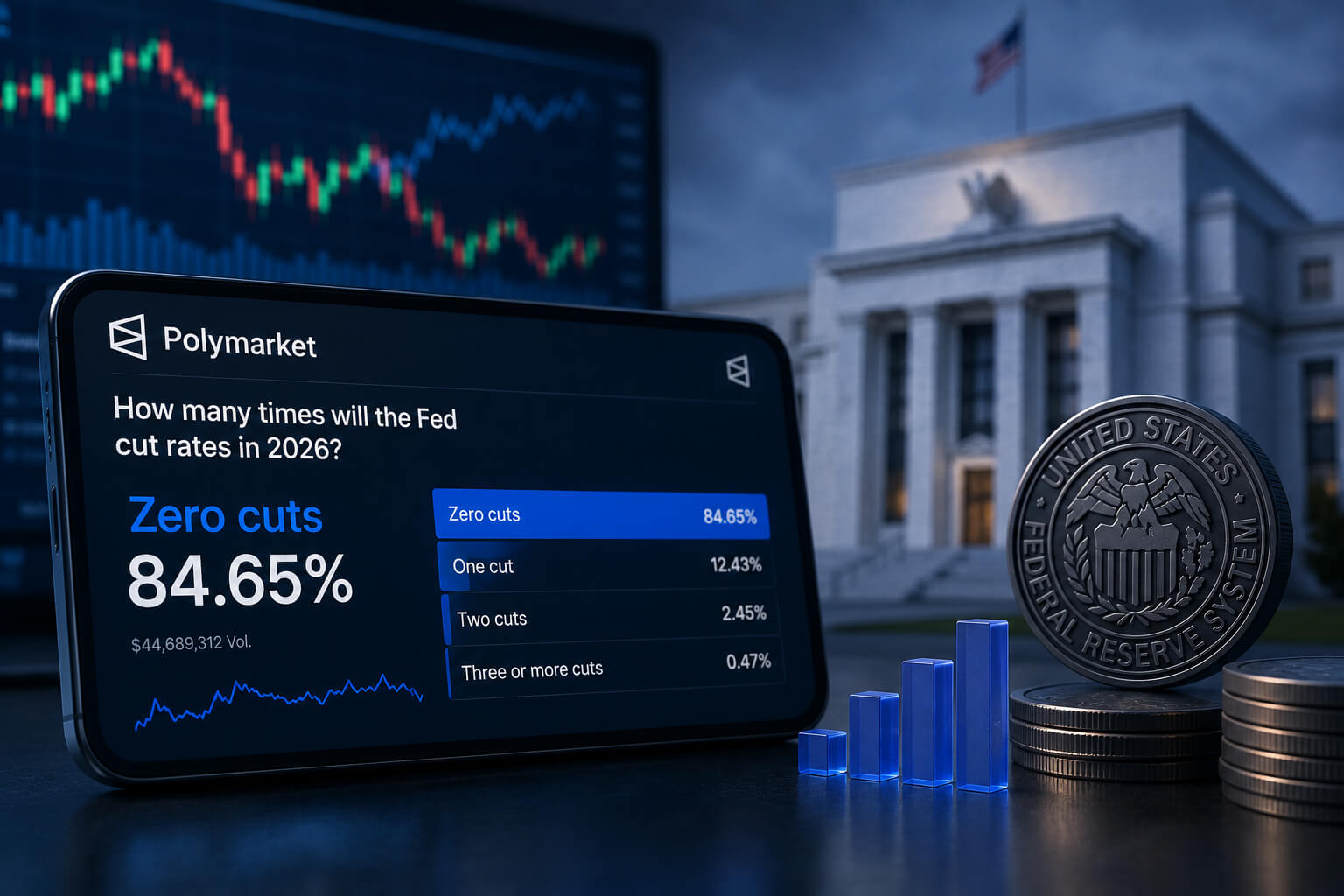
Polymarket traders placed an 84.65% implied probability on the Federal Reserve delivering zero interest rate cuts during 2026, according to market figures reported on July 22. Trading volume across the contract had reached approximately $44.59 million.
That is more than a casual bet on the next central bank meeting. It reflects a much harder view of the entire year.
The one-cut outcome stood at only 9.5%, while two cuts attracted odds of roughly 3.25%. Beyond that, probabilities dropped close to the floor. Three cuts were priced at 1.25%, showing just how firmly traders had gathered around the no-cut scenario.
Polymarket Fed Rate Cuts Market Leans Heavily Toward Zero
Polymarket’s “How many Fed rate cuts in 2026?” contract works as a ladder rather than a single yes-or-no market. Traders can buy positions tied to zero cuts, one cut, two cuts and several higher outcomes.
At the time the figures were reported, zero cuts sat far above every other option:
Zero cuts carried odds of 84.65%. One cut was priced at 9.5%, two cuts at 3.25%, and three cuts at 1.25%.
The zero-cut contract had also gained about 4.5 percentage points over both the previous 24 hours and seven days. That move suggests traders were not simply holding an old position. Conviction had strengthened during the week.
Still, an 84.65-cent market price is not an official economic forecast. It is the value traders currently assign to the outcome. Prices can move quickly when inflation, employment or Federal Reserve commentary changes.
The Federal Reserve Has Kept Rates Unchanged All Year
The market’s position is not appearing out of nowhere.
The Federal Open Market Committee has maintained its target range for the federal funds rate at 3.5% to 3.75% since the beginning of 2026. At its June meeting, the committee again kept rates unchanged and emphasized its commitment to restoring price stability.
That matters because the calendar is already moving into the second half of the year. Every meeting that passes without a cut leaves fewer opportunities for an easing cycle to develop before December.
The Fed is not required to cut at a scheduled meeting, of course. It could also move more than once if economic conditions changed sharply. Polymarket traders simply see little reason to price that in right now.
The market closes at the end of December 2026, so plenty can still happen. But the starting point has become unusually one-sided.
Inflation Still Makes the Fed’s Decision Difficult
The latest US inflation figures gave policymakers a mixed picture.
The Consumer Price Index fell 0.4% in June on a seasonally adjusted monthly basis. That was a meaningful decline, helped by lower energy prices. Over the previous 12 months, however, consumer prices remained 3.5% higher. Core inflation, which removes food and energy, stood at 2.6% year over year.
One month of falling headline prices does not automatically clear the way for lower interest rates.
Annual inflation remains above the Fed’s 2% goal, while policymakers must also consider employment, economic growth and the possibility that temporary price declines could reverse. The July Monetary Policy Report noted that inflation had moved higher during recent months, keeping price stability firmly at the center of the debate.
That tension helps explain the Polymarket pricing. Traders are not necessarily saying the economy is booming or that inflation will surge again. They appear to believe the Fed lacks enough evidence—or enough urgency—to reduce rates before the year ends.
One Fed Rate Cut Is Still the Main Alternative
Although the zero-cut outcome dominates, the market has not completely dismissed a late move.
The one-cut contract remained the strongest alternative at 9.5%. That would most likely require a noticeable change in economic conditions, such as faster progress on inflation, weaker employment numbers or a sudden slowdown in economic activity.
Two or more cuts would demand a larger shift.
The market assigned only 3.25% to two cuts and even less to three. For those outcomes to gain ground, traders would probably need to see several weak data releases rather than one surprising report.
Watch the lower rungs of the ladder. A real change in sentiment would not only push the zero-cut probability downward. It would also send more money into the one-cut and two-cut contracts.
Prediction Markets Are Becoming Part of the Fintech Data Stack
The $44.6 million trading volume is almost as interesting as the odds.
Prediction markets are increasingly functioning like live sentiment engines for economic policy. Instead of waiting for a monthly analyst survey, users can see how traders price new information almost immediately.
An inflation report arrives. A Fed official speaks. Employment numbers surprise. The probabilities move.
That makes platforms such as Polymarket useful for investors, fintech companies and financial publishers trying to understand how expectations are shifting. The market does not replace economists, futures contracts or official central bank guidance. It adds another signal.
And because participants have money at risk, the numbers often attract more attention than an ordinary online poll.
What No Fed Rate Cuts Could Mean for Fintech and Crypto
A full year without rate cuts would keep borrowing costs elevated for consumers and businesses. That pressure can reach several areas of fintech, including digital lending, buy now, pay later services, mortgage technology and startup funding.
Companies that depend heavily on cheap capital may face a tougher environment. Lenders could continue dealing with cautious borrowers and higher repayment risks. Investors may also remain selective when valuing loss-making fintech businesses.
Crypto markets have their own sensitivity to interest rates. Lower rates can make risk assets more attractive by reducing returns available from cash and government debt. A prolonged pause does not automatically push digital assets lower, but it removes one of the easier sources of speculative momentum.
The bigger message is not that every fintech stock or cryptocurrency must react in the same direction. It is that the expected monetary-policy tailwind keeps getting pushed further away.
Polymarket Odds Can Change Before December
An 84.65% probability looks decisive. It is not permanent.
The Federal Reserve still has several policy decisions ahead, along with months of inflation, employment and economic data. An unexpected recession signal, financial disruption or rapid cooling in prices could reshape the market within hours.
For now, though, Polymarket traders have settled on a fairly stark conclusion.
The Fed has already spent the first half of 2026 holding rates steady. Most traders now believe it will finish the year the same way.