

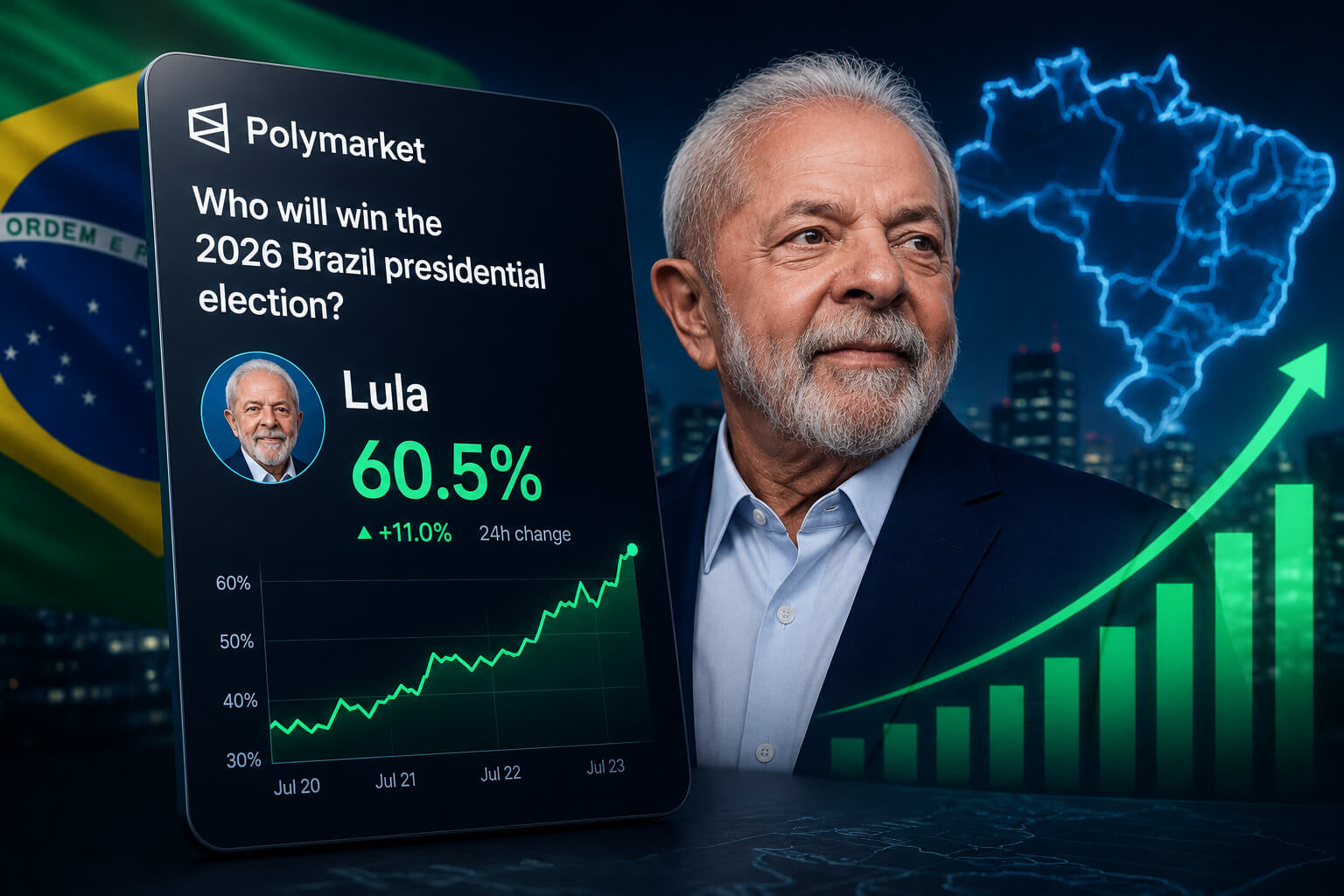
Luiz Inácio Lula da Silva has opened a sizeable lead in one of Polymarket’s biggest political prediction markets, though the numbers are moving fast enough that nobody should treat them as settled.
Lula’s implied probability of winning Brazil’s 2026 presidential election reached 60.5%, climbing 11 percentage points from 49.5%. More than $114.6 million had been traded across the market when the figures were reported.
That is a serious amount of activity for a non-US political contract. It also shows how prediction markets are becoming another place where traders attempt to price political risk before voters reach the ballot box.
Lula’s Brazil Election Odds Move Above 60%
The price of a Lula “Yes” contract rose to 60.5 cents, which translates into an implied probability of roughly 60.5%. A winning contract pays $1 when the market resolves, while an unsuccessful contract becomes worthless.
Flávio Bolsonaro sat well behind Lula at 24.6%, while Renan Santos held an implied probability of 11.4%. Ronaldo Caiado followed at approximately 1.8%.
That gap matters. Traders are not currently pricing Brazil’s election as a perfectly balanced race. At least for now, money has concentrated around Lula rather than spreading evenly across several possible winners.
Prediction-market odds are not opinion polls, of course. They reflect what traders are willing to pay. Liquidity, breaking news, large individual positions and sudden changes in sentiment can all shift the price.
Sometimes dramatically.
The 11-Point Jump Needs Some Caution
The headline increase looks clear: Lula moved from 49.5% to 60.5%.
The underlying market picture is messier.
Blockchain.News also reported that Lula’s contract had fallen by around 12 percentage points across shorter 24-hour and seven-day windows, suggesting heavy two-way trading rather than a smooth rise in confidence.
In other words, the market has been volatile. Lula may hold the lead, but traders have repeatedly changed their positions as political headlines, polling updates and campaign developments enter the picture.
One detail deserves extra caution. The report linked the latest repricing to a local election headline from Chandler, Arizona. That event has no direct connection to Brazil’s presidential field, and the original article acknowledges that it does not directly address the Brazilian race.
The price move is real. The suggested explanation is far less convincing.
Brazil’s Presidential Race Is Taking Shape
Brazil will hold the first round of its presidential election on October 4, 2026. Lula is seeking another term under the Workers’ Party, while Senator Flávio Bolsonaro is carrying the political banner associated with his father, former President Jair Bolsonaro.
Jair Bolsonaro is not running. He remains ineligible, leaving his son as the most prominent candidate connected to Brazil’s right-wing Bolsonaro movement.
The contest has shifted several times. Earlier polling showed Lula and Flávio Bolsonaro running close in possible second-round scenarios. Flávio’s position later weakened following reports about recorded conversations involving a request for funding from a Brazilian banker accused of fraud.
Lula’s position has also been helped by the fragmented field around him. Several centre-right and right-wing candidates remain in contention, including Renan Santos and Ronaldo Caiado. That makes it harder for anti-Lula support to gather behind one challenger before the race fully consolidates.
Why Prediction Markets Matter to Fintech
This is not only an election story.
Polymarket sits at the intersection of political forecasting, blockchain infrastructure and financial speculation. Traders buy and sell outcome-based contracts, with prices moving according to supply and demand.
For fintech companies, these markets are becoming a live experiment in how financial platforms can package news, probability and public sentiment into tradable products.
They also expose the limitations.
A 60.5% price does not mean Lula has secured 60.5% of the vote. It does not guarantee that he will win. The figure represents the market’s collective pricing of one specific outcome at one moment.
Large traders can influence thin markets. Headlines can produce exaggerated reactions. Traders may also misunderstand a report, follow momentum or use one market to hedge another position.
More than $114 million in trading volume gives the Brazil contract weight, but volume alone does not turn a market price into a reliable forecast.
Brazil’s Economy Could Drive the Next Repricing
Brazil’s economic outlook will likely play a much larger role in the election than an unrelated local political result in the United States.
Investors are watching the country’s fiscal position, government debt, interest rates and relations with major trading partners. Brazil is also dealing with renewed trade tension with the United States, creating another issue for candidates to use during the campaign.
Foreign policy disputes can quickly become domestic election issues. So can inflation, employment and the cost of borrowing.
That gives Polymarket traders plenty to react to between now and October. A new poll, political scandal, economic release or candidate withdrawal could change the odds within hours.
Polymarket Gives Lula a Lead, Not a Victory
Lula’s 60.5% implied probability makes him the clear Polymarket frontrunner, while Flávio Bolsonaro remains the nearest major alternative at 24.6%.
Still, the market has already shown sharp swings. Treating the latest number as a final forecast would miss the point.
Prediction markets are snapshots. Expensive, highly traded snapshots, in this case, but snapshots all the same.
The more useful signal may be the distance between Lula and his closest challenger. Should that gap continue to widen while trading volume rises, confidence in a Lula victory would look stronger. If it begins to close, the Brazilian election could quickly return to coin-flip territory.