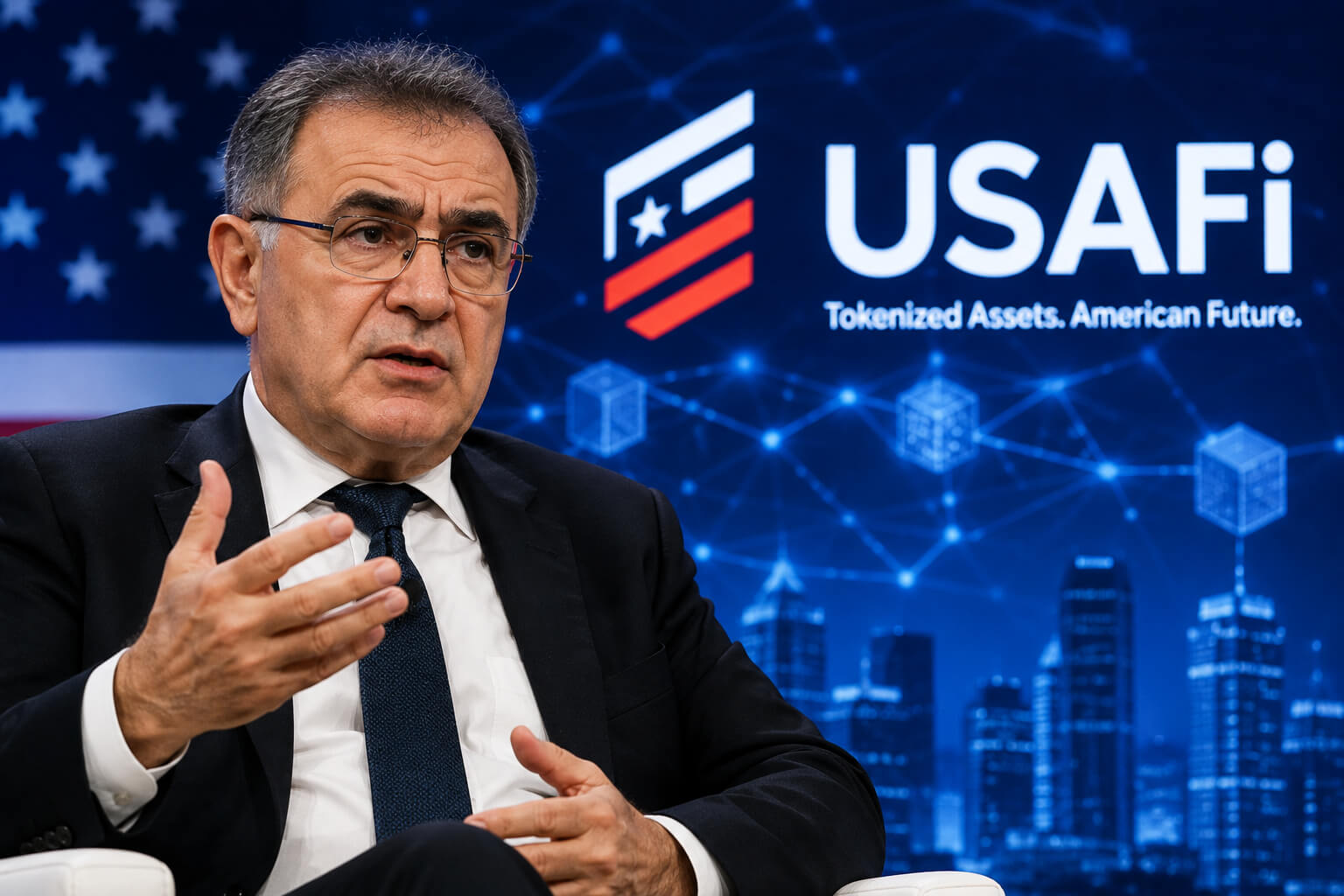
Nouriel Roubini, one of the world’s most famous cryptocurrency critics, is now backing a blockchain-based financial product — but not the kind of crypto asset he has criticized for years.
The economist, widely known as “Dr. Doom” for predicting the 2008 financial crisis, has co-authored a whitepaper for USAFi, a tokenized investment product being developed by Atlas Capital Team. The move marks a notable shift for Roubini, who has long argued that many cryptocurrencies lack real-world value, intrinsic backing, and investor protection.
Instead of embracing speculative tokens, Roubini is supporting a blockchain product tied to traditional financial assets. USAFi is designed as a tokenized version of the Atlas America Fund ETF, a Nasdaq-listed fund connected to Atlas and overseen by Roubini. The project aims to bring real-world asset exposure onto blockchain rails while maintaining a link to regulated financial markets.
What Is USAFi?
USAFi is being positioned as a tokenized investment product backed by the Atlas America Fund ETF. The fund is built around assets such as U.S. Treasuries, real estate, gold, and agricultural commodities. Its goal is to provide a more resilient investment strategy during periods of inflation, market volatility, geopolitical risk, and economic uncertainty.
By turning exposure to this fund into a blockchain-based token, Atlas wants to make the asset easier to transfer, settle, and access globally. The company is pitching the product as part of a broader “Technodollar” concept — a digital reserve asset backed not by pure crypto speculation, but by real-world financial instruments.
This is an important distinction. Roubini has not suddenly become a Bitcoin maximalist or a supporter of meme coins. His move appears to reflect a growing divide between speculative cryptocurrencies and tokenized real-world assets, also known as RWAs.
Why Roubini’s Blockchain Move Matters
Roubini’s involvement is significant because he has been one of crypto’s most vocal skeptics. For years, he criticized digital assets for volatility, fraud risks, weak fundamentals, and lack of real backing. His decision to support a tokenized asset project suggests that blockchain’s strongest institutional use case may not be replacing traditional finance, but modernizing parts of it.
Tokenization allows traditional assets such as funds, bonds, stocks, and Treasury products to be represented on blockchain networks. Supporters argue this can improve settlement speed, transparency, liquidity, and access. Instead of waiting for legacy market hours and traditional settlement systems, tokenized assets can potentially move around the clock.
For institutional investors, this is one of the most closely watched areas of blockchain adoption. Major financial firms have already moved into tokenized funds and real-world asset products, signaling that blockchain infrastructure is becoming more relevant to mainstream capital markets.
Roubini’s participation adds another layer to that trend. If even one of crypto’s harshest critics sees value in blockchain-based settlement for real-world assets, it strengthens the argument that tokenization is becoming a serious financial infrastructure theme.
Dubai’s Role in the USAFi Launch
Atlas plans to issue USAFi under Dubai’s Virtual Assets Regulatory Authority framework. Dubai has been positioning itself as a global hub for regulated digital assets, and the USAFi project highlights how jurisdictions outside the United States are competing to attract tokenization projects.
The planned launch under Dubai’s VARA framework is important because tokenized assets require both technological infrastructure and regulatory clarity. For institutional-grade products, the key issue is not only whether an asset can be issued on-chain, but whether it can operate within a recognized legal and compliance environment.
Atlas has described the project as a regulated, real-asset-backed token that can be accessed and traded in a permissionless environment. That combination — regulated backing with blockchain-native movement — is central to the appeal of real-world asset tokenization.
Securitize to Support Tokenization Infrastructure
Securitize, a major tokenization infrastructure provider, is expected to support the USAFi project. The company has become one of the best-known names in bringing traditional securities and funds onto blockchain networks.
Its involvement reinforces the idea that tokenization is no longer a niche crypto experiment. The sector increasingly sits at the intersection of asset management, securities law, fintech, and blockchain infrastructure.
For investors, the key question will be whether tokenized products like USAFi can offer meaningful advantages over conventional ETFs, stablecoins, and money market products. These advantages could include faster settlement, broader global access, improved transferability, and potential use in blockchain-based financial applications.
Real-World Assets Become a Major Blockchain Narrative
The USAFi project arrives as real-world asset tokenization becomes one of the most important narratives in blockchain. Unlike speculative cryptocurrencies, RWAs are tied to off-chain assets such as government bonds, private credit, real estate, commodities, or investment funds.
This makes them more attractive to institutions that want blockchain efficiency without full exposure to crypto volatility. Tokenized Treasuries and tokenized funds have already seen strong interest, especially from investors looking for yield-bearing digital assets.
Roubini’s involvement could accelerate mainstream discussion around this sector. His reputation as a crypto skeptic makes the move more surprising, but also more meaningful. It suggests that opposition to speculative crypto does not necessarily mean opposition to blockchain technology itself.
A Turning Point for Blockchain Adoption?
Roubini’s backing of USAFi does not mean he has reversed all his views on crypto. Instead, it shows that blockchain is being separated into two categories: speculative digital assets and regulated financial infrastructure.
That distinction may shape the next phase of blockchain adoption. Bitcoin, Ethereum, stablecoins, and meme coins continue to dominate public attention, but institutional finance is increasingly focused on tokenized funds, settlement systems, and real-world asset products.
USAFi could become a test case for whether blockchain can deliver practical benefits to traditional investors. If the project succeeds, it may encourage more asset managers to explore tokenized versions of ETFs, funds, and other regulated products.
For the blockchain industry, Roubini’s move sends a clear message: the strongest argument for blockchain may not be hype, speculation, or replacing the entire financial system. It may be making real-world assets more accessible, programmable, and efficient.
Bottom Line
Nouriel Roubini’s support for USAFi marks a notable moment for blockchain adoption. One of crypto’s best-known critics is now backing a tokenized asset project — not because he has embraced speculative crypto, but because he sees a use case for blockchain when it is connected to real-world assets and regulatory oversight.
For Breaking Blockchain News readers, the takeaway is clear: tokenization is becoming one of the most important bridges between traditional finance and blockchain technology. Roubini’s involvement gives that trend a powerful new headline.