
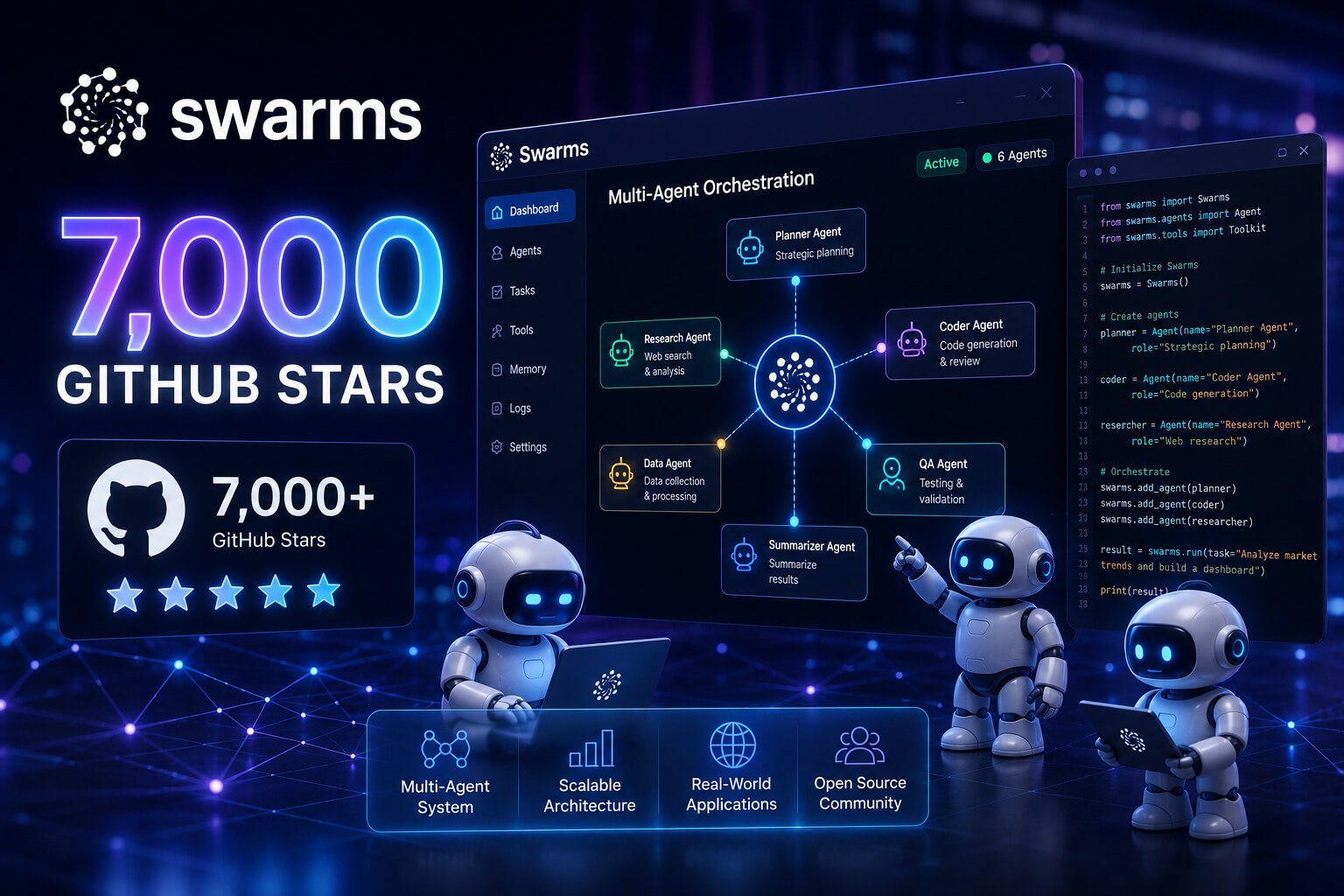
Swarms has crossed 7,000 GitHub stars, a small-looking number that says more than it first appears to.
The open-source multi-agent orchestration framework has been gaining attention among developers building systems where several AI agents work together instead of relying on one model to handle everything alone. The milestone was highlighted on July 17, 2026, after Swarms passed the 7,000-star mark on GitHub, signaling stronger developer interest in agent-based AI infrastructure.
That may sound like another open-source badge. It is not exactly that.
In the AI and blockchain space, developer traction matters because it often comes before larger ecosystem activity. A framework that attracts builders can later become the base layer for tools, marketplaces, tokenized agents, automation platforms, and enterprise experiments.
Swarms Is Becoming Harder to Ignore
Swarms describes itself as a production-ready multi-agent orchestration framework. In plain terms, it helps developers build AI systems made up of several agents that can divide tasks, share work, run in sequence, operate in parallel, or follow a hierarchy. The project supports different architectures, including sequential workflows, concurrent workflows, hierarchical swarms, group-chat agents, mixture-of-agents setups, and other swarm topologies.
That matters because single-agent AI has limits. One chatbot can answer, summarize, or generate. A network of agents can break a job into pieces. One agent researches. Another checks. Another writes. Another reviews. Another executes a tool call. Messier, yes. But closer to how real work happens.
For blockchain builders, that idea is especially interesting. Web3 already runs on distributed coordination. Multi-agent AI brings a similar design pattern into software workflows, where many autonomous or semi-autonomous units can cooperate around tasks.
The 7,000-Star Milestone Shows Developer Confidence
GitHub stars are not revenue. They are not users. They are not proof that a project will win.
Still, they are a useful signal.
Passing 7,000 stars shows that Swarms is getting attention from developers who are watching, testing, saving, or contributing to the project. Its GitHub repository presents Swarms as an enterprise-grade framework for production-ready multi-agent orchestration, with support for sequential, concurrent, and hierarchical systems.
Open-source AI infrastructure often grows this way. First the repository gets noticed. Then examples appear. Then developers start building internal tools. Then companies ask whether it can handle real workloads. Not always. But often enough.
Swarms is also leaning heavily into production use, not just demos. Its website says the framework includes orchestration, memory, tools, observability, concurrency, and composable workflows in Python. It also claims support for more than 1,000 models across major providers and compatible endpoints.
Why Multi-Agent AI Fits the Blockchain Conversation
The blockchain angle is not just marketing.
AI agents are increasingly being discussed as economic actors, workflow operators, trading assistants, DAO contributors, research bots, and automated market participants. A single agent can do some of that. A coordinated group of agents could do more complicated work, especially when tasks involve research, verification, execution, and monitoring.
Swarms sits near that shift. Its framework is not only about making chatbots talk to each other. It is about building agent systems that can handle structured workflows. That could include crypto research desks, compliance automation, smart contract review, data analysis, portfolio monitoring, or on-chain agent marketplaces.
The project’s own materials point to use cases across finance, healthcare, engineering, research, marketing, and operations. For blockchain companies, finance and operations are the obvious entry points. Research and engineering may be next.
Open Source Gives Swarms an Edge
There is another reason this milestone matters: Swarms is open source.
The framework is licensed under Apache 2.0, which makes it easier for developers and companies to inspect, fork, modify, and deploy the technology without being locked into one vendor.
That is important in AI infrastructure. Many teams are cautious about handing mission-critical workflows to closed systems they cannot fully inspect. Open-source frameworks give technical teams more control, even if they still use commercial models underneath.
For Web3 builders, open infrastructure has an added appeal. Blockchain communities tend to prefer systems that are transparent, composable, and community-driven. Swarms appears to be positioning itself in that lane.
The Bigger Shift: AI Agents Are Moving Past Experiments
The broader story is not just Swarms reaching 7,000 stars.
The bigger story is that multi-agent AI is moving from research language into developer tooling. Frameworks like Swarms are trying to make agent coordination easier to build, observe, and scale. That is the hard part. Not the flashy demo. The plumbing.
Swarms says its stack includes structured logging, telemetry, token accounting, tracing, memory integrations, model flexibility, and concurrency support. Those details may not sound exciting, but they are exactly what teams need when they stop playing with agents and start deploying them.
There are still challenges. Multi-agent systems can become expensive. They can be harder to debug. Agents can disagree, loop, duplicate work, or produce confident nonsense at scale. The technology is promising, but not magic.
That is why developer adoption matters. More users usually means more feedback, more bug reports, more examples, and better patterns for real deployment.
What Comes Next for Swarms
Swarms crossing 7,000 GitHub stars gives the project more visibility at a time when AI agent infrastructure is becoming one of the more active areas in tech.
The next test is not whether developers keep starring the repository. The real test is whether teams keep building with it after the first experiment. Can it support production workloads? Can it manage complex agent behavior without becoming fragile? Can it find a real place in blockchain, finance, and enterprise automation?
For now, the signal is clear enough. Developers are paying attention. Multi-agent AI is no longer sitting quietly in the research corner. And Swarms, with its open-source framework and growing community, has pushed itself into the conversation.