
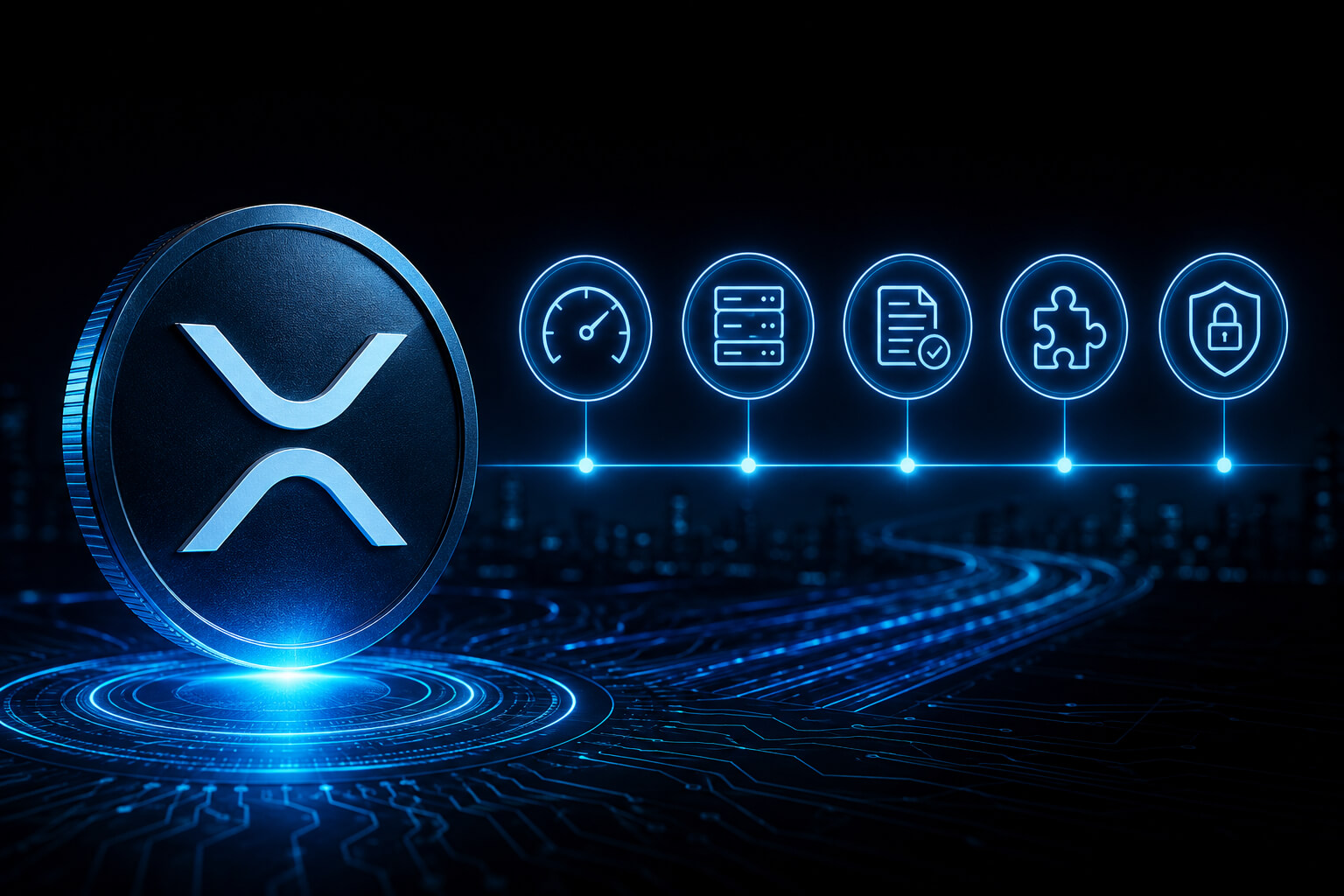
The XRP Ledger is starting to look quite different from the network many crypto investors became familiar with.
For years, the pitch around XRPL was fairly straightforward: fast settlement, cheap transactions and XRP as a bridge asset. That story hasn’t disappeared. But it is no longer the whole story.
A series of XRP Ledger updates is pushing the network toward tokenized assets, institutional trading, credit markets and privacy-focused transactions. Some pieces are already running on the network. Others have entered the amendment process or are still being developed.
And things are moving quickly. XRPL version 3.3.0 was released on August 6, 2026, bringing another batch of proposed protocol changes including ConfidentialTransfer, DynamicMPT, account permission delegation and transaction sponsorship.
That’s a much bigger shift than another routine blockchain upgrade.
Multi-Purpose Tokens Are Becoming More Capable
Tokenization is one of the clearest areas where XRPL is expanding.
Multi-Purpose Tokens, usually called MPTs, give issuers a more structured way to create fungible assets on the XRP Ledger. These aren’t limited to speculative crypto tokens. The model can be used for things such as stablecoins, tokenized deposits, securities, commodities or other real-world assets.
The interesting part now is how deeply MPTs are being woven into the rest of XRPL.
Vaults can work with them. Permissioned environments can incorporate them. Lending infrastructure can use them. And XRPL 3.3.0 introduced the proposed DynamicMPT amendment, which adds more flexibility around properties such as metadata, transfer fees and issuance capabilities.
That may sound like plumbing. In practice, plumbing matters.
A bank issuing a tokenized financial product has very different requirements from somebody launching a meme coin. Issuers may need authorization controls, transfer restrictions, clawback functionality or rules that become permanent once configured.
XRPL is increasingly being built around those kinds of requirements.
Whether institutions actually use the tools at scale is another question.
Permissioned Trading Gives Institutions Their Own Lane
Public blockchains have always had an awkward problem when it comes to regulated finance.
Everyone can participate.
That’s the point — until a financial institution needs to know exactly who its counterparty is.
XRPL’s Permissioned Domains and Permissioned DEX infrastructure attack that problem directly. A permissioned domain can define which credentials users must hold before entering a particular financial environment. Those credentials can then be used to restrict access to specific markets.
The transactions still settle on the XRP Ledger. The network doesn’t suddenly become private. Instead, access to a particular market can be controlled.
That difference is important.
Banks, asset managers and regulated token issuers may want blockchain settlement without being forced to interact with completely unknown counterparties. Permissioned markets create a middle ground: public blockchain infrastructure with restrictions around participation.
There’s an obvious weakness too.
Liquidity can fragment.
Ten separate regulated markets aren’t automatically better than one deep open market. If permissioned order books remain thin, technically impressive infrastructure won’t magically create efficient markets.
Still, this is probably one of XRPL’s more practical institutional upgrades.
Token Escrow Moves XRPL Beyond XRP-Only Settlement
Escrow isn’t new to the XRP Ledger. What has changed is what can go inside it.
The TokenEscrow amendment expanded escrow functionality beyond XRP, allowing supported issued assets to be locked and released under specified conditions.
That opens up fairly ordinary financial use cases — and ordinary isn’t necessarily bad.
A company could use token escrow for scheduled distributions. A tokenized security could have controlled settlement. Stablecoins could potentially be locked for delayed payment. Vesting and milestone-based releases become easier to build directly around ledger-native functionality.
Then there’s the more experimental part: Smart Escrows.
The proposal takes the idea further by allowing custom logic to determine when an escrow releases assets. That could eventually support things like delivery-versus-payment transactions, oracle-triggered settlements or automated compliance conditions.
It isn’t the same approach Ethereum took.
Rather than turning XRPL into a giant general-purpose execution environment, the idea is narrower: add programmability where it serves a specific financial function.
That restraint could become a strength. It also doesn’t remove the technical risk. More programmable logic means more ways for something to go wrong.
Native Lending Could Be the Bigger Economic Experiment
Payments move money.
Lending creates markets around money.
That makes XRPL’s lending push particularly interesting.
Version 3.1.0 of the XRP Ledger software introduced the SingleAssetVault and LendingProtocol amendments into the server release. The proposed system allows assets to be pooled into vaults, which can then provide capital for fixed-term loans.
This isn’t simply another copy of collateral-heavy crypto lending.
The design supports uncollateralized lending, with loan brokers handling underwriting and managing risk parameters. Loan creation, repayments, impairment and defaults can then be represented on the ledger.
Think trade finance. Private credit. Institutional stablecoin lending. Corporate borrowing.
And yes, potentially XRP-denominated credit.
That last part will get plenty of attention from XRP holders, but it shouldn’t be assumed.
Stablecoins have an obvious advantage in lending because borrowers generally prefer knowing what currency their debt is denominated in. XRP could participate as an asset inside this ecosystem without necessarily becoming its dominant loan currency.
The 3.2.0 release also included precision and rounding fixes affecting Single Asset Vaults and the Lending Protocol, showing that the infrastructure is still being hardened as development progresses.
There’s real potential here. There’s also real credit risk. A blockchain can make bad loans transparent. It can’t magically make them good loans.
Confidential Transfers Could Solve an Awkward Blockchain Problem
Privacy gets complicated very quickly when institutional money enters public blockchains.
Imagine a fund moving a large tokenized position.
On a completely transparent network, competitors may be able to observe balances, transfers and other clues about what the institution is doing. That’s great for transparency. Less great when those transactions reveal trading strategies or sensitive client activity.
XRPL 3.3.0 now includes the ConfidentialTransfer amendment proposal for Multi-Purpose Tokens. It uses cryptographic techniques including zero-knowledge proofs to keep transferred amounts hidden while allowing the transaction and balances to remain verifiable.
That’s a more nuanced idea than simply making transactions anonymous.
The objective is closer to selective financial privacy.
Institutions may eventually be able to prove that transactions obey certain rules without revealing every underlying detail to everyone watching the ledger.
If that works reliably, it could become one of XRPL’s most important features for tokenized finance.
But confidentiality on a public blockchain is technically hard. Regulators may also have very different ideas about how much information financial institutions should be allowed to conceal.
This one is worth watching rather than assuming it’s solved.
XRPL 3.3.0 Adds More Than Privacy
Confidential transfers grabbed attention, but the August 2026 XRPL 3.3.0 release included several other proposed changes.
BatchV1_1 brings back atomic batch transactions, allowing multiple transactions to be grouped so they can execute together.
PermissionDelegationV1_1 is designed to let accounts hand specific permissions to another account without surrendering complete control.
Then there’s Sponsor.
This amendment could be quietly important for mainstream applications because it allows another entity — perhaps a company or token issuer — to cover transaction fees and reserve requirements for a user.
Most regular people don’t want to learn about blockchain reserves before using a financial app.
If someone can open an application, receive a token and interact without first buying XRP purely to handle network mechanics, XRPL applications become much easier to hide behind normal consumer interfaces.
Ironically, making the blockchain less noticeable could help the blockchain get used more.
Does Any of This Mean XRP Will Rise?
Not automatically.
This is where the conversation around XRP Ledger updates often gets ahead of itself.
A blockchain becoming more useful does not guarantee that its native asset appreciates at the same rate.
XRP still has several roles inside the network. Transactions consume small amounts of XRP as fees. Account and ledger-object reserves create XRP requirements. XRP can also function as an auto-bridge between assets.
New applications could bring more activity, liquidity and demand into that system.
But institutions could also use XRPL heavily while conducting much of their actual business in stablecoins and tokenized assets.
That distinction matters.
The more meaningful question isn’t whether XRPL receives another five amendments. It’s whether those features create sustained financial activity — active markets, token issuance, credit, settlement volume and liquidity that actually touches XRP.
The XRP Ledger Is Becoming a Financial Platform
XRPL’s direction in 2026 is increasingly obvious.
Payments are still part of the network, but the ambitions have widened.
Tokenization gives issuers more sophisticated assets. Permissioned markets give regulated participants controlled environments. Escrows add programmable settlement. Vaults and lending introduce credit. Confidential transfers attack the privacy problem.
There’s even infrastructure aimed at hiding blockchain complexity from end users through sponsored fees and reserves.
None of those features, individually, guarantees that XRP becomes more valuable.
Taken together, though, they show where the XRP Ledger is heading.
The next chapter for XRPL probably won’t be decided by how many transactions it can process or how cheaply XRP can move from one wallet to another. Those questions were answered years ago.
The harder test starts now: can the network convince financial institutions and developers to actually build meaningful markets on top of it?
That’s the part worth watching.
Sources
- Bitcoin Foundation — “XRP Blockchain Updates: 5 Major XRPL Changes That Could Transform XRP’s Future”
- XRP Ledger — “Introducing XRP Ledger version 3.3.0,” published August 6, 2026
- XRP Ledger — “Introducing XRP Ledger version 3.2.0,” published June 15, 2026
- XRP Ledger — “Introducing XRP Ledger version 3.1.0”
- XRP Ledger Documentation — Permissioned Domains
- XRP Ledger Documentation — Known Amendments