
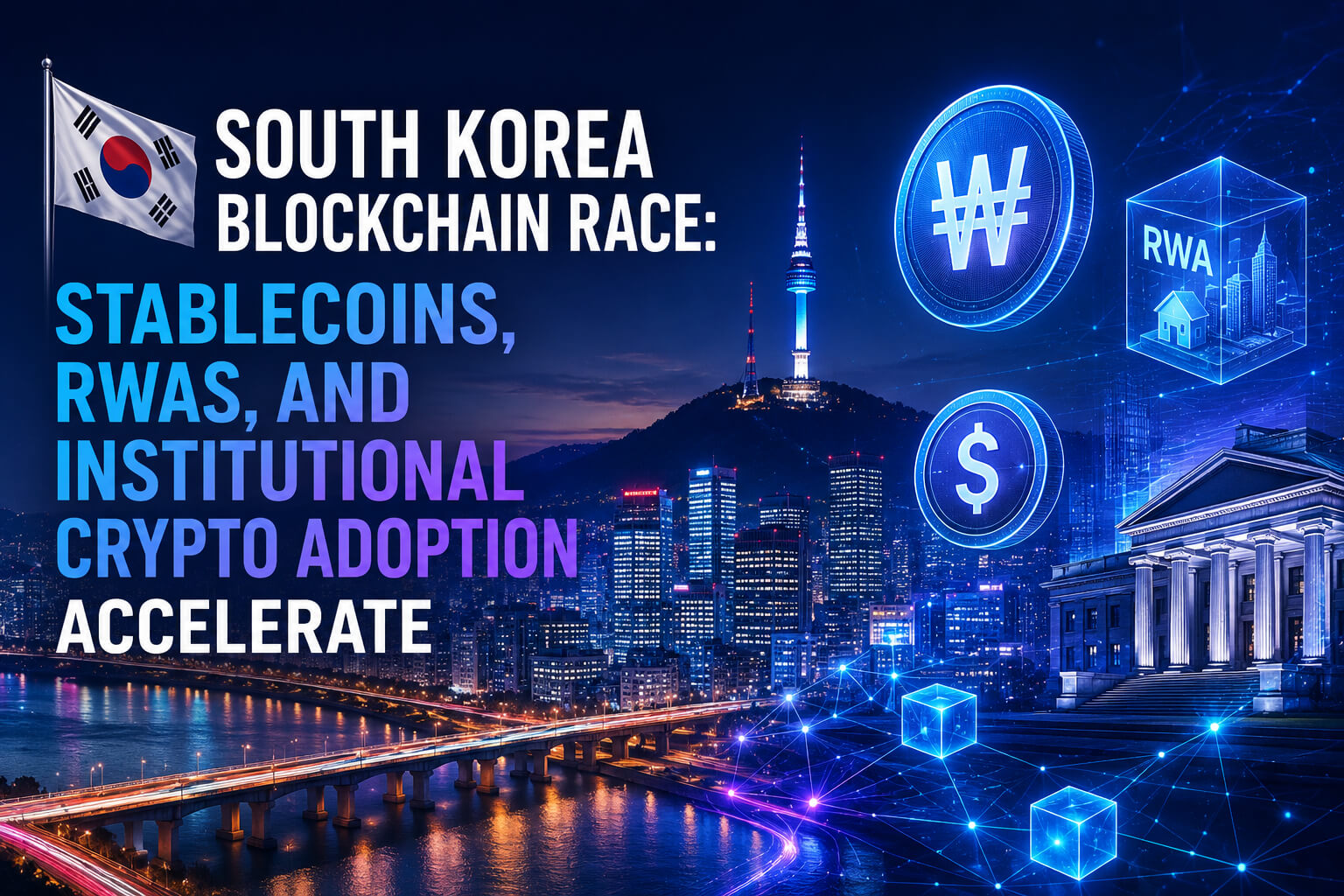
South Korea is entering a new phase in its blockchain journey. Once known mainly as one of the world’s most active retail crypto markets, the country is now becoming a serious testing ground for institutional blockchain adoption.
Banks, payment networks, securities firms, and major internet platforms are exploring how blockchain can support digital payments, stablecoins, real-world asset tokenization, remittances, settlement, and consumer-facing financial services.
This shift marks an important moment in the South Korea blockchain race. The country is no longer just a market where crypto investors trade tokens. It is becoming a place where large institutions are preparing for the next generation of financial infrastructure.
South Korea’s Crypto Market Is Moving Beyond Retail Trading
South Korea has long played a major role in global crypto markets. During previous crypto cycles, Korean investors were known for driving strong trading activity, while listings on major local exchanges such as Upbit and Bithumb became important milestones for blockchain projects.
But the market is changing.
Retail trading remains part of the ecosystem, but the bigger story today is institutional preparation. South Korea’s financial and technology leaders are exploring blockchain use cases that go far beyond speculation. Their focus is increasingly on regulated stablecoins, tokenized securities, payment infrastructure, and blockchain-powered financial rails.
This is happening as regulators and policymakers consider how digital assets should fit into Korea’s financial system. While the legal framework is still developing, many companies are already building partnerships, testing pilots, and positioning themselves for a more regulated blockchain future.
Stablecoins Are Becoming a Key Priority in South Korea
One of the biggest drivers of the South Korea blockchain race is the growing interest in stablecoins.
Stablecoins are digital assets designed to maintain a stable value, often pegged to fiat currencies such as the U.S. dollar. In South Korea, the debate is increasingly focused on whether the country should allow regulated won-backed stablecoins.
The issue is both commercial and strategic. Dollar-denominated stablecoins such as USDC and USDT already play a major role in global crypto markets. For Korean banks and policymakers, the concern is that too much digital money activity could move outside domestic financial rails if dollar stablecoins dominate payments, trading, and remittances.
A regulated Korean won stablecoin could help keep more digital finance activity connected to local institutions, local currency, and Korean regulation.
However, key questions remain. Should banks be the main issuers of won-backed stablecoins? Should fintech companies and internet platforms also be allowed to compete? How should regulators balance innovation with monetary control and consumer protection?
These questions are still being worked through, but institutions are not waiting passively.
Korean Banks Are Testing Blockchain Payments and Remittances
Major Korean banks are already experimenting with blockchain-based financial services.
KB Financial Group has tested blockchain payments and remittance use cases, including QR-code payments and cross-border money transfers. These pilots show how blockchain infrastructure could make payments faster and potentially cheaper than traditional systems.
Hana Financial Group is also active in the space. Its connection to Dunamu, the operator of Upbit, gives it a stronger link to Korea’s crypto market than many traditional banks. Hana has participated in stablecoin-related remittance testing and is exploring how digital assets can fit into financial services.
NH Bank is focusing on merchant settlement use cases through partnerships with payment infrastructure companies. KBank, Korea’s first internet-only bank and Upbit’s banking partner, is exploring stablecoin wallets and remittance services.
Together, these moves show that Korean banks are not treating blockchain as a distant experiment. They are testing practical use cases that could become important once regulation becomes clearer.
Payment Companies Are Building Stablecoin Infrastructure
South Korea’s payment industry is also becoming an important part of the blockchain race.
Card companies and payment networks already have the merchant relationships, user base, and settlement systems needed to bring stablecoin payments into the real economy. That makes them powerful partners for blockchain projects.
Shinhan Card has partnered with blockchain ecosystem players to explore stablecoin payment infrastructure. BC Card has tested stablecoin spending for foreign visitors at Korean merchants. These experiments show how stablecoins could be routed through familiar card payment systems rather than requiring entirely new consumer behavior.
Danal is another company to watch. With its Paycoin network and large merchant footprint, Danal already has distribution in digital payments. Its work around a won-pegged stablecoin highlights how payment companies may use blockchain to expand existing networks rather than replace them.
The key takeaway is simple: stablecoin adoption in South Korea may not come only from crypto apps. It may come through familiar payment brands, merchant networks, and card infrastructure.
Kakao, NAVER, and Toss Could Bring Blockchain to Consumers
Consumer platforms may become one of the most important parts of South Korea’s blockchain future.
Kakao and NAVER are deeply embedded in everyday digital life in Korea. Kakao operates KakaoTalk, the country’s dominant messaging app, while NAVER is Korea’s leading internet platform with search, news, payments, commerce, and financial services.
These platforms already have something many blockchain projects struggle to build: user distribution.
If stablecoins, wallets, and tokenized assets are integrated into platforms that millions of Koreans already use, blockchain adoption could become much more mainstream. Instead of asking users to download unfamiliar crypto apps, blockchain services could appear inside existing payment and messaging ecosystems.
NAVER’s connection to Dunamu and Upbit could be especially important if the deal receives regulatory approval. Combining a major crypto exchange with a widely used payment platform could create one of the strongest consumer blockchain distribution channels in Asia.
Kakao is also exploring blockchain and stablecoin opportunities through its financial subsidiaries. A future “super wallet” concept could potentially connect messaging, banking, payments, fiat currency, and stablecoins in one consumer interface.
Toss is another major player. With banking, securities, insurance, payments, and offline point-of-sale infrastructure, Toss already operates like a broad financial platform. Its interest in won stablecoins and blockchain infrastructure could make it a serious competitor in Korea’s digital asset ecosystem.
Real-World Asset Tokenization Is Gaining Momentum
Stablecoins are only one side of the South Korea blockchain race. Real-world asset tokenization is another major trend.
Real-world asset tokenization, or RWA tokenization, refers to bringing assets such as real estate, bonds, gold, carbon credits, intellectual property, and other financial products onto blockchain networks.
Globally, much of the RWA conversation has focused on U.S. Treasuries and private credit. South Korea appears to be taking a broader and more locally specific approach.
Korean securities firms are exploring tokenized assets linked to real estate, bonds, gold, carbon credits, short-term debt, shipping, defense supply chains, and entertainment intellectual property.
This matters because South Korea has global strengths in industries such as shipping, manufacturing, defense, technology, and entertainment. Tokenization could allow Korean institutions to create blockchain-based financial products tied to sectors where the country already has deep expertise.
Securities Firms Are Preparing for Tokenized Markets
Korean securities firms are positioning themselves for a future where tokenized securities become part of regulated capital markets.
Mirae Asset Securities, Hanwha Investment & Securities, Shinhan Investment Securities, NH Investment Securities, and other firms are exploring tokenized asset products and infrastructure.
Some projects are focused on investment contracts and fractional ownership. Others are looking at maritime assets, intellectual property, and industrial supply chains.
The legal foundation is also developing. South Korea has moved toward clearer rules for security token offerings, with new frameworks expected to support tokenized issuance and trading in the coming years.
This could create opportunities for blockchain infrastructure companies that support custody, compliance, interoperability, settlement, liquidity, and global distribution.
Why Crypto-Native Projects Should Pay Attention
South Korea’s blockchain market offers major opportunities for crypto-native projects, but the market requires a different approach from pure retail crypto growth.
Large Korean institutions move carefully. They value trust, regulatory clarity, long-term relationships, and practical infrastructure. Projects that want to succeed in Korea need to show how they can help banks, payment companies, securities firms, and platforms improve what they already do.
The biggest opportunities may be in three areas:
1. Stablecoin infrastructure
Banks, payment networks, and consumer platforms will need wallets, settlement systems, compliance tools, custody, and blockchain rails.
2. RWA tokenization support
Securities firms may need infrastructure for issuance, trading, interoperability, liquidity, and cross-border investor access.
3. Consumer distribution partnerships
Platforms such as NAVER, Kakao, and Toss could become major gateways for mainstream blockchain usage.
Crypto companies that build relationships early may have an advantage once regulation becomes clearer. By the time the market fully opens, many key decisions around technology partners, chains, wallets, custody providers, and infrastructure vendors may already be made.
South Korea Could Become a Major Blockchain Infrastructure Hub
South Korea has several ingredients needed to become a major blockchain market: strong financial institutions, advanced technology platforms, high digital adoption, active crypto users, and a government working toward clearer rules.
The country’s next blockchain chapter will likely be shaped by institutions rather than retail traders alone.
Banks may help define stablecoin issuance and compliance. Securities firms may lead tokenized asset markets. Payment networks may bring stablecoins into merchant settlement. Internet platforms may bring wallets and blockchain services to everyday users.
This makes South Korea one of the most important markets to watch in Asia’s institutional blockchain race.
Final Thoughts
The South Korea blockchain race is accelerating, but it is still early. Regulation remains a key factor, and many pilots have not yet reached full commercial scale. Still, the direction is clear.
South Korea’s largest banks, payment companies, securities firms, and consumer platforms are preparing for a blockchain-powered financial future.
For crypto-native projects, the opportunity is not just to enter the Korean market after regulation is finalized. The opportunity is to build relationships now, prove real use cases, and become part of the infrastructure that institutions will rely on when the market matures.
South Korea is no longer just a retail crypto hotspot. It is becoming one of Asia’s most important laboratories for stablecoins, tokenized assets, and institutional blockchain adoption.